My research and creative practice operates on two wavelengths:
~ exploring creative methods for illuminating the politics, cultures, and epistemologies animating the infrastructural pipelines for digital – and especially AI/ML – systems.
+
~ studying how social worlds narrate and negotiate the political stakes of their digital ecologies
~creative methods for critical digital studies~
“Do Graphics Processing Units Have Politics?”
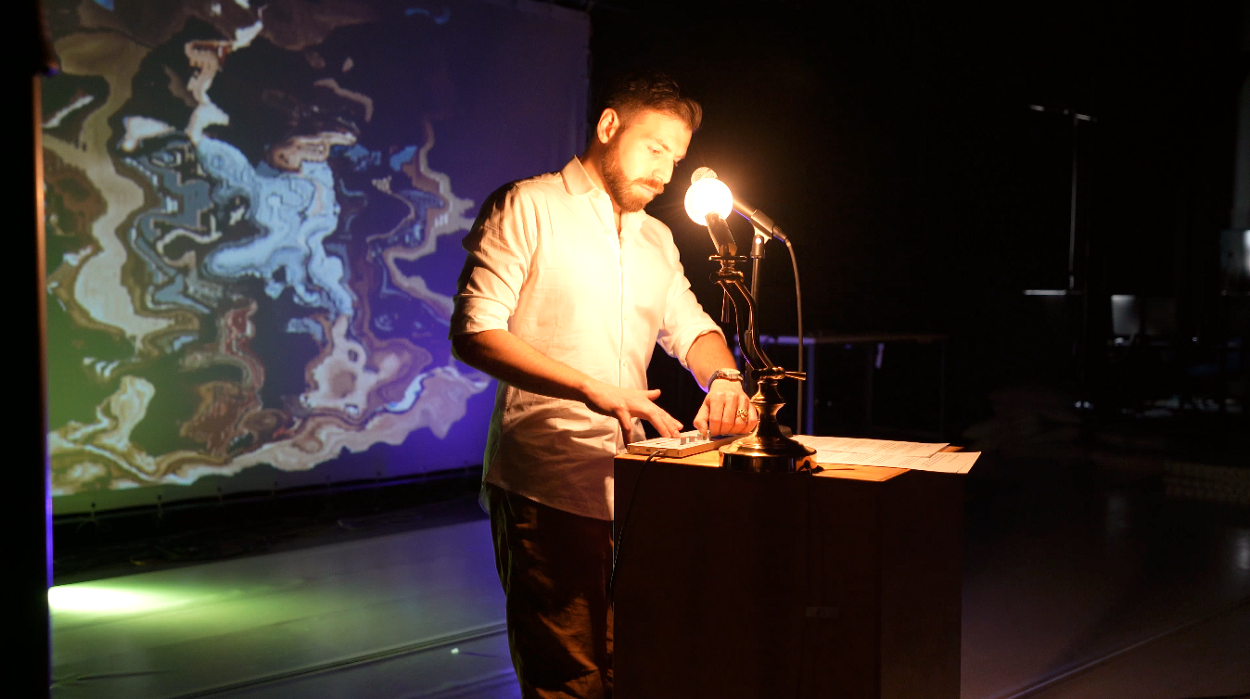
In the middle of the 20th century, computer science researchers began to explore what it would take to produce a responsive graphical interface to mediate the interactions between people and computers. By the mid-1980s, the results of this research took on the form of the graphics processing unit, or GPU.
Do Graphics Processing Units Have Politics? (2022) traces this story back to its roots at the University of Utah, and then continues on to the early 2010s, when a different group of computing researchers stumbled across the startling efficacy of GPUs for what had been for decades a mostly unpopular and only moderately successful set of methods for developing ‘artificial intelligence’ programs: artificial neural networks. The collision between GPUs and neural networks electrified the computer science world, leading to the AI renaissance in which we currently find ourselves in the early 2020s. But the mesh between GPUs and neural networks requires a third ingredient: training data, and lots of it. Who produces that training data? And what does the production of training data mean for AI’s promises of automation?
Notes on Do GPUs…?
This project owes many debts – in particular to Jacob Gaboury’s Image Objects: An Archaeology of Computer Graphics, Mary Gray & Siddarth Suri’s Ghost Work: How to Stop Silicon Valley from Building a New Global Underclass, Phil Jones’ Work Without the Worker: Labour in the Age of Platform Capitalism, and papers by Lily Irani, Moritz Altenreid, Tim Hwang, and Sarah Hooker, among others. (A full bibliography can be found here.)
Note: the animated images projected during this performance are being generated in real-time using the signal from the synthesizer played onstage to ping a neural network trained on the same ImageNet dataset discussed in the performance.
Performance created by Ben Gansky, with visuals by Shawn Lawson.
Developed with support from the Experimental Humanities Collaborative Network and Tamarack Arts Center. Awarded Honorable Mention by the Society for the Social Studies of Science Making & Doing Section (2022).
“Encountering the Border Laboratory”
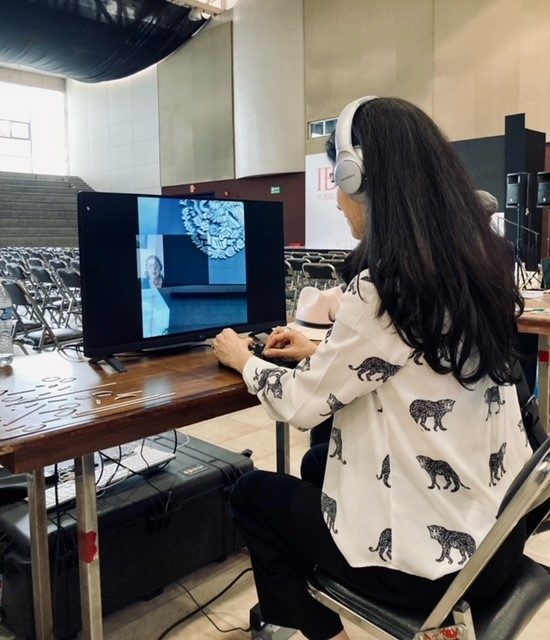
Developed collaboratively with the STS Borderlands Laboratory at Arizona State University, this intermedia installation opened an encounter with materials and concepts brought together through ethnographic engagement with the mediated and informatized northern and southern borders of Mexico.
Participants were invited to engage with the installation in several ways. If they chose to sit in front of the screen and listen via headphones, they were greeted with a collage of moving images whose degree of superimposition they could control via the jaguar-headed knobs in front of them. One layer of images was composed of video fragments of borderland landscapes recorded by research team members during fieldwork. Another layer juxtaposed video clips from lectures, advertisements, and journalism featuring representations of different border technologies. The position and relative transparency of the expert ‘talking heads’ were directly controllable by the installation participant. What the participant heard was also under their influence: either the audio from the border tech-related video clips or a sort of ‘directors commentary’ in which members of the research team interviewed each other, reflecting on the process of documenting border media and ‘hybrid technologies’ through a database of forensic identification and digital communication technologies encountered through fieldwork. Throughout, the experience was underscored with music composed by team member Octavio Muciño Hernandez, drawing on motifs from Mexican popular music traditions. The participant was seated in such a way that their own face was always, but barely, visible in reflection on the screen. Elsewhere in the installation, discrete items from the database, such as locations, names, classifications, and dates, were represented on small magnetic strips, which participants were invited to make meaning of through new spatial and conceptual arrangements.
This installation, for which I served as creative director, was awarded the 2022 Making & Doing Prize by the Society for the Social Studies of Science.
“Future Perfect: A Postcapitalist Adventure”
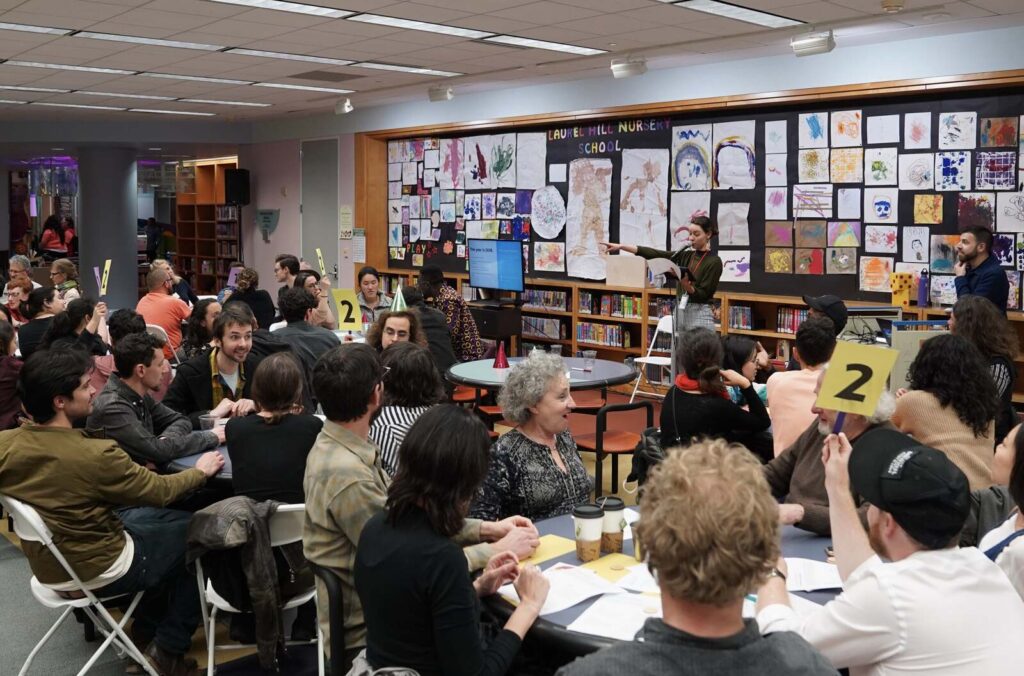
Developed by my organization Free Machine to generate creative and provocative conversations around democracy and technology, Future Perfect: a Postcapitalist Adventure is a group choose-your-own-adventure in which participants take on the role of neighborhood council members in an imagined society.
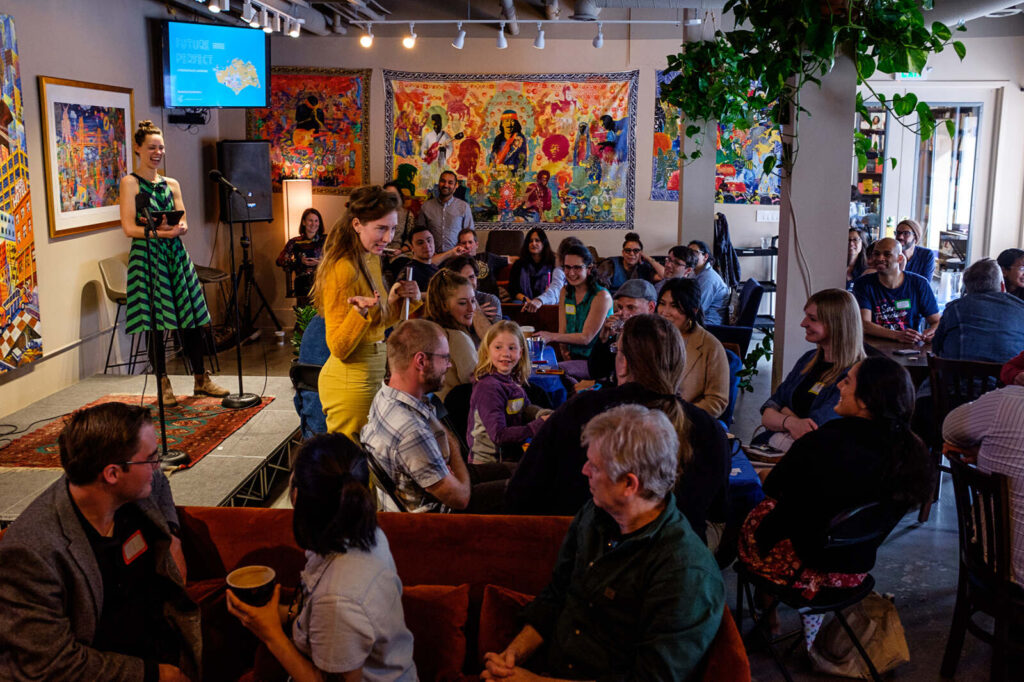
Over the course of twenty years in office, the neighborhood councils are confronted with a series of dilemmas arising from climate crises and technological developments relating especially to automation and artificial intelligence. They must debate and vote on their policy responses, and depending on what the councils choose, the future could look very different…
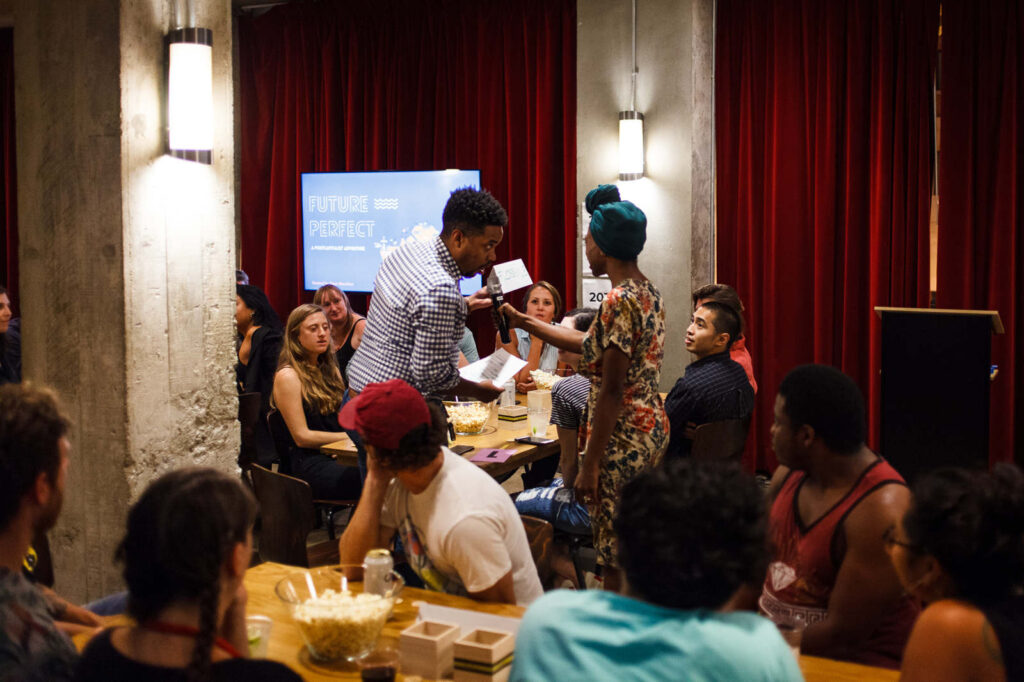
Created by Free Machine
Presented 2018 – 2020 at Ace Hotel LA, Manny’s (SF), Cucalorus Film Festival, San Francisco Night of Ideas, and Avenidas Senior Living Center
Awarded Special Commendation by the Society for Social Studies of Science, Making & Doing Section (2021)
~digital governance~
“The Politics of AI Systems are Inextricable from Their Supply Chains: Public Values Versus the Digital Political Economy”
This peer-reviewed article tells the story of a multi-year dispute between Oregon city planners and the startup building an AI tool for them. Using emails obtained through public records requests, I show how claims of trade secrecy and opaque data pipelines made it nearly impossible for the planners to know how the system worked—or to hold it accountable. The story reveals that the politics of AI aren’t hidden in the algorithms, but in the complex networks of corporations, contracts, and data transactions that shape how these tools are built and used.
The Politics of AI Systems are Inextricable from Their Supply Chains: Public Values Versus the Digital Political Economy (AAAI/ACM AI Ethics & Society 2025 pre-print)
“Dependency Craftwork: Governing Digital Tools in Public Interest Collectives”
My dissertation project (2025) examines how public interest collectives adopt, adapt, and contest digital technologies in ways that reflect and reshape their normative commitments. Across these case studies, I develop the concept of dependency craftwork to describe how actors actively reshape the social, legal, and technical dependencies that define their digital infrastructures. Dependencies, rather than being eliminated or passively inherited, are sites of situated intervention and value contestation. Rather than seeking to eliminate dependency, public interest actors engage in the craftwork of transforming dependencies into more just and accountable interdependencies. The findings offer a framework for understanding how the practice of digital governance can open possibilities for nurturing relations of reciprocity and interdependence within and across social worlds working towards more just and inclusive futures.
“Artificial Intelligence is Too Important to Leave to Google and Facebook Alone”
This op-ed argues that governments across scale and jurisdiction must not leave the development of AI technologies as the exclusive purview of profit-driven entities, and proposes a variety of tactics by which government can promote the development of AI/ML capabilities in the public interest.
Artificial Intelligence is Too Important to Leave To Google and Facebook Alone (NYTimes Privacy Project 2019) – with Michael Martin and Ganesh Sitaraman
Open source governance leadership (ongoing)
After three years of research on Decidim, an open source platform used around the world to structure participatory democratic processes (e.g. participatory budgeting), I was elected to the project’s Coordination Committee (equivalent to a board of directors) in 2024. My primary project there thus far has been the design and facilitation of an ongoing inclusive participatory process for the renovation of the organization’s bylaws.
Civic technology participant-ethnography (ongoing)
In summer 2025 I began a participant-ethnography within the IT Department of the city government of Minneapolis. My job title there is ‘Principal Business Analyst’, which affords me the opportunity to spend time with departmental leadership and staff across City departments as I conduct interviews and observations. The material collected through this fieldwork will complement my doctoral project’s case studies towards the development of a monograph on ‘dependency craftwork’ in public interest digital governance.